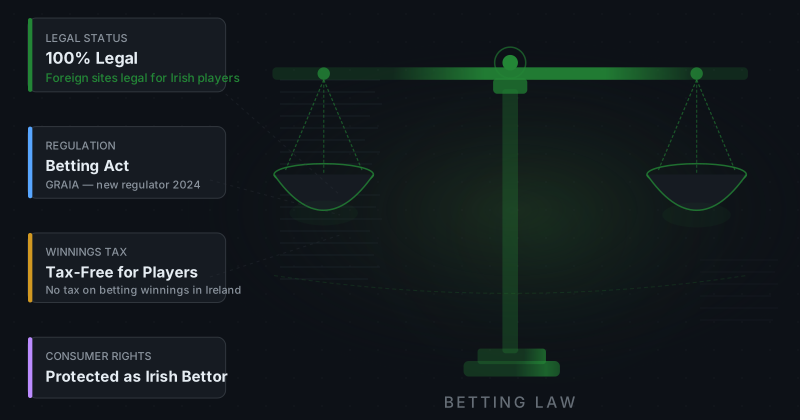
Thousands of Irish players use foreign betting sites every day, but many are unsure of their legal standing. The short answer is: yes, it is legal for Irish residents to bet on foreign-licensed bookmakers. This guide explains the legal framework in full, what the Gambling Regulation Act 2024 actually changed, and how to identify trustworthy operators.
Legal Status: Can Irish Players Use Foreign Sites?
Irish law has never prohibited individuals from betting with foreign bookmakers. The Betting Act 1931 (as amended) and subsequent legislation regulate the operation of betting businesses in Ireland, not the behaviour of customers placing bets. There is no statute that makes it an offence for an Irish resident to place a bet on a foreign-licensed site.
This position is consistent with EU law: as an EU member state, Ireland cannot restrict its citizens from accessing services legally provided by operators in other EU member states. Even for operators outside the EU (e.g. Curaçao-licensed sites), Irish law imposes no criminal or civil liability on players.
The Gambling Regulation Act 2024
The Gambling Regulation Act 2024 (GRA) is the most significant reform of Irish gambling law in almost a century. It replaced the outdated Betting Acts and established the Irish Gambling Regulatory Authority (IGRA) as the new independent regulator.
What the GRA changed
The main changes introduced by the Gambling Regulation Act 2024 are:
Key provisions of the GRA 2024
- Establishment of the Irish Gambling Regulatory Authority (IGRA)
- New licensing categories for online and land-based operators
- Mandatory responsible gambling measures (deposit limits, cooling-off periods)
- National self-exclusion register (GAMSTOP equivalent)
- Stricter advertising rules, including watershed restrictions
- Social media gambling advertising restrictions
- Dedicated fund for gambling harm research and treatment
What the GRA did not change
The GRA does not make it illegal for Irish players to use foreign-licensed sites. IGRA will regulate operators who wish to advertise to or accept bets from Irish customers — but enforcement against foreign operators is a matter of ongoing regulatory development. In 2026, there is no practical restriction on Irish players accessing international bookmakers.
Betting Tax in Ireland: What Players Pay
Irish players do not pay tax on their betting winnings. Gambling winnings are explicitly excluded from income tax and capital gains tax under Irish Revenue rules. This applies whether you bet with an Irish bookmaker or a foreign one.
The betting duty (currently 2% on stakes) is a tax on operators, not players. Irish-licensed bookmakers typically absorb this cost, while foreign bookmakers operating from lower-tax jurisdictions have a structural pricing advantage that contributes to their better odds.
Which Gambling Licences Should You Trust?
Not all gambling licences offer the same level of player protection. Before registering with a foreign bookmaker, check which authority has licensed it.
| Licence | Jurisdiction | Player Protection Level | Dispute Resolution |
|---|---|---|---|
| Malta Gaming Authority (MGA) | Malta / EU | High | MFSA / EADR |
| UK Gambling Commission (UKGC) | UK | Very High | IBAS / ADR schemes |
| Gibraltar | UK Overseas Territory | High | Gibraltar Licensing Authority |
| Curaçao | Caribbean | Moderate | Limited — operator-managed |
EU vs. Irish Bookmakers: Key Differences
The most tangible differences Irish players experience between domestic and foreign bookmakers relate to odds, account policies, and payment processing. Foreign bookmakers generally offer lower overrounds (better value odds), do not operate on a "square market" model designed around the domestic levy structure, and are far less likely to restrict winning accounts.
Related Pages
- How the Gambling Regulation Act 2024 affects Irish bettors — detailed breakdown
- Do Irish players pay tax on betting winnings? — full tax guide
- Which gambling licences should you trust? — MGA, UKGC, Curaçao explained
- EU bookmakers vs. Irish-licensed sites — key differences
- How to verify a foreign betting site is safe — due diligence guide
- Best foreign betting sites for Irish players — full overview
Frequently Asked Questions
Is it illegal for Irish players to bet on foreign sites?
No. Irish law does not prohibit individuals from betting on foreign-licensed bookmakers. The Gambling Regulation Act 2024 regulates operators, not individual players. You can legally use any properly licensed international bookmaker from Ireland.
Do I pay tax on winnings from foreign betting sites?
No. Betting winnings are not considered taxable income in Ireland, regardless of whether the bookmaker is Irish or foreign. There is no capital gains tax or income tax on gambling winnings for Irish residents.
What did the Gambling Regulation Act 2024 change?
The GRA 2024 established the Irish Gambling Regulatory Authority (IGRA) to oversee domestic gambling operators. It introduced stricter advertising rules, player protection requirements, and a national self-exclusion register. It does not restrict Irish players from using foreign sites.
Are EU bookmakers safer than non-EU ones?
EU-licensed bookmakers (MGA, Gibraltar, UKGC) are generally subject to stricter regulatory oversight and player protection standards than Curaçao-licensed operators. However, many reputable bookmakers hold Curaçao licences and have long track records of fair play.
What is the difference between Irish-licensed and foreign-licensed bookmakers?
Irish-licensed bookmakers pay Irish betting duty and are subject to IGRA oversight. Foreign bookmakers pay taxes in their licensing jurisdiction. For players, the main practical differences are account restriction policies, odds levels, and available payment methods.