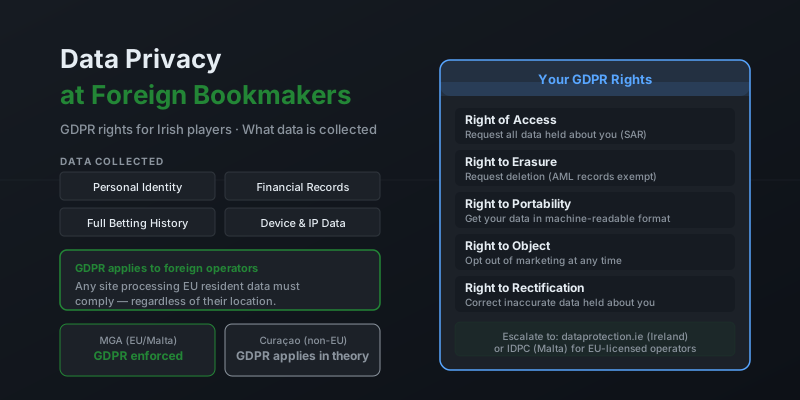
Registering with a foreign betting site involves sharing significant personal information — identity documents, payment details, and an ongoing record of your betting activity. Understanding what data is collected, how it is stored, and what rights you have is an important part of using international bookmakers safely. This guide covers data collection practices, GDPR applicability, and your rights as an Irish player.
What Data Is Collected
Foreign betting sites are legally required to collect substantial personal information as part of their Anti-Money Laundering (AML) and Know Your Customer (KYC) obligations. Before your first significant withdrawal, you will be asked to verify your identity with:
- Government-issued photo ID (passport or driving licence)
- Proof of address (utility bill, bank statement)
- Payment method verification (bank statement or card photograph)
Data Stored on an Ongoing Basis
Beyond identity verification, bookmakers collect and store the following throughout your account lifetime:
Types of Data Collected by Foreign Bookmakers
- Personal data: Name, date of birth, address, email, phone number, nationality
- Financial data: Payment methods used, deposit and withdrawal history, transaction amounts and dates
- Betting history: Every bet placed — sport, market, odds, stake, outcome — is stored permanently
- Technical data: IP addresses, device identifiers, browser type, session timestamps
- Behavioural data: Pages visited, time spent on site, responsible gambling tool usage
- Communication history: All customer support interactions, emails, live chat transcripts
GDPR and Foreign Operators
The General Data Protection Regulation (GDPR) applies to any organisation that processes the personal data of EU/EEA residents, regardless of where the organisation is located. Since Irish players are EU residents, foreign bookmakers that accept them are subject to GDPR obligations when processing Irish players' data.
MGA-Licensed Operators and GDPR
Malta is an EU member state, so MGA-licensed bookmakers operate within the EU legal framework and are directly subject to GDPR. They must appoint a Data Protection Officer (DPO) for organisations processing data at scale, maintain records of processing activities, and respond to data subject requests (access, deletion, portability) within 30 days.
Curaçao-Licensed Operators and GDPR
Curaçao is outside the EU, so local Curaçao law does not enforce GDPR compliance. However, the GDPR's extraterritorial reach means the obligation still applies in theory when processing EU resident data. In practice, enforcement against Curaçao-based operators by EU data protection authorities is more complex, making data rights somewhat harder to exercise against non-EU licensed operators. This is one practical advantage of choosing MGA-licensed bookmakers.
What to Look For in a Privacy Policy
A compliant privacy policy will clearly state: what data is collected, the legal basis for processing each type of data (consent, contract, legal obligation), retention periods, whether data is shared with third parties, and how to exercise your data subject rights. If a privacy policy is vague, uses generic language, or is undated, treat this as a yellow flag.
Your Rights as an Irish Player
Under GDPR, Irish players have the following rights regarding their personal data held by foreign bookmakers:
- Right of access: Request a copy of all personal data held about you (a Subject Access Request, or SAR). The operator must respond within 30 days.
- Right to rectification: Request correction of inaccurate data held about you.
- Right to erasure: Request deletion of personal data. Note: bookmakers can decline deletion of data required for legal compliance (AML records, KYC documents, financial transactions).
- Right to data portability: Request your data in a structured, machine-readable format to transfer to another service.
- Right to object: Object to processing of your data for direct marketing purposes. This is an absolute right — the operator must comply.
To exercise any of these rights, contact the bookmaker's Data Protection Officer (DPO) or customer support team. If you believe your rights have been violated by a bookmaker licensed in the EU (e.g., MGA), you can escalate to the relevant national data protection authority — in Malta's case, the Information and Data Protection Commissioner. Irish players can also contact the Data Protection Commission Ireland.
Related Pages
- How to verify a foreign betting site is safe — full safety guide
- Gambling licences explained — MGA, UKGC, Curaçao
- No-KYC betting sites — options for privacy-conscious players
- Is it legal to use foreign betting sites in Ireland?
Frequently Asked Questions
Is my data safe at a foreign betting site?
Reputable foreign bookmakers use SSL encryption for data transmission and store personal and financial data securely. MGA-licensed operators are subject to GDPR-aligned data protection requirements as an EU regulator. That said, you should always read the privacy policy before registering to understand exactly what data is collected and how it is used.
Does GDPR apply to non-EU betting sites?
Yes, GDPR applies to any organisation that processes the personal data of EU/EEA residents, regardless of where the organisation is based. If a foreign bookmaker accepts Irish players, it is processing the data of EU residents and is therefore subject to GDPR obligations. In practice, enforcement varies by the operator's jurisdiction, but the right exists.
Can I request my data be deleted?
Under GDPR, you have the right to request erasure of your personal data (the "right to be forgotten"). However, bookmakers are legally required to retain certain financial and identity records for AML compliance purposes — typically for 5–7 years after account closure. They may decline deletion of data required for legal compliance while still deleting non-essential data.
What information does a foreign bookmaker store about me?
At a minimum: your name, address, date of birth, email, phone number, government ID document (for KYC), payment method details, deposit and withdrawal history, full betting history, IP addresses used to log in, and device identifiers. Marketing preferences and communication history are also stored.